
Use Case
High water level inspections: ZIPCAM 360 rises to the challenge for South Fork Sewer District
| Reasons for acquiring the ZIPCAM 360 | Details |
|---|---|
| Operational autonomy and simplicity | The district wanted an affordable alternative to traditional crawlers (CCTV/RST/POSM) with improved operational efficiency. |
| Inspecting high-water level pipes | The ZIPCAM 360 allows an all-in-one tandem dewatering and inspection capabilities, with a single truck. |
| Optimization of limited manpower | Allows a single team of two technicians to perform tasks that previously required two crews and coordinated logistics. |
| Matching inspection and cleaning pace | The goal is to inspect 20,000 linear feet per year, ensuring that every foot cleaned is also documented for quality control. |
The District operates a large territory with two wastewater treatment plants and over 130,000 ft of sanitary sewer pipe, with a small crew of just four operators. The District’s goal is to implement an inspection program that maximizes the efficiency of its operations staff while leveraging a proactive asset management approach.
Its network includes a 15 to 36-inch reinforced concrete main interceptor with typical flows at 30-50% pipe capacity, a condition that complicates inspections. In this context, the traditional method using an inspection crawler requires two vehicles: a jetter truck to lower the water level downstream, and a second vehicle dedicated to the camera. This approach typically requires more resources, adds logistical complexity, and increases costs.
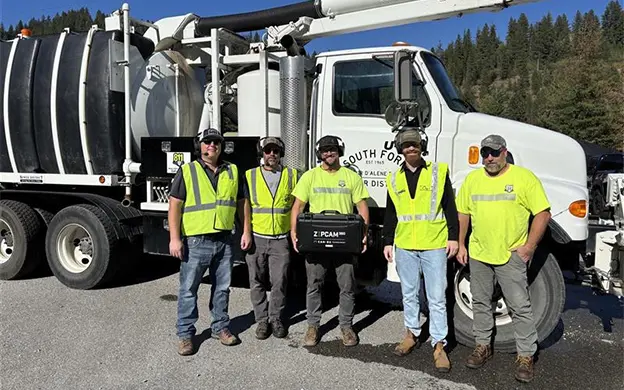
From Left to Right : Peter Stayton (District Manager), Josh Seaton (Operator), Tyler Wingerson (Operator), Cole Caldwell (Can-Ex Technologies), James Trogden (Plant Operator).

The Shoshone County Valley; Photo from South Fork Sewer District.
The Solution: Simultaneous Pipe DEWATERING and Inspection with ZIPCAM 360
Can-Ex Technologies supported the South Fork Sewer District team during the commissioning of their ZIPCAM 360, directly on the main interceptor. The ZIPCAM 360 natively integrates a simultaneous draining capability: by keeping its jets active while pulling the camera back toward the truck, the water is pushed downstream, lowering the water level in front of the 360 camera lens. Inspection and draining are performed in the same operation, with no second vehicle and no additional crew.


The high water level in the South Fork sewer network just before the inspection. The ZIPCAM 360 is almost fully submerged.
Water level during inspection on the return segment. The nozzle jets lower the water level as the ZIPCAM 360 travels back downstream (all-in-one tandem).
“Before adopting the ZIPCAM 360, our approach was to clean about one-third of the network early in the season, then return later to perform inspections with our CCTV system. In practice, we were cleaning far more than we were inspecting, simply because of resource limitations.
Today, with the ZIPCAM 360, inspection is integrated directly into every cleaning operation. We systematically follow each cleaning with a quality check, which means we are using the ZIPCAM 360 all the time. We make sure the pipe is properly cleaned before closing the manhole, while documenting its condition at the same time. It gives us a much more complete picture of the overall condition of our sewer network.
Cleaning operations can take a little longer in the field with the added inspection step, but in the end, it is absolutely worth it. We are inspecting far more than we used to.”
— Peter Stayton, South Fork Sewer District Manager

One of the Silver Valley’s water treatment plants.
What the ZIPCAM 360 Concretely Changes for South Fork Sewer District
Where the traditional method required two vehicles and two coordinated crews, the ZIPCAM 360 accomplishes the same work with a single truck, in a single field operation by two technicians, even if the pipes are flooded.
Inspections are thus much faster and greatly simplified. Operational costs are cut in half, and the district is making concrete progress toward greater autonomy in its underground infrastructure asset management.
For small and medium-sized municipalities facing demanding inspection conditions, the ZIPCAM 360 is an approach that is accessible, high-performing, and compliant with NASSCO PACP standards.